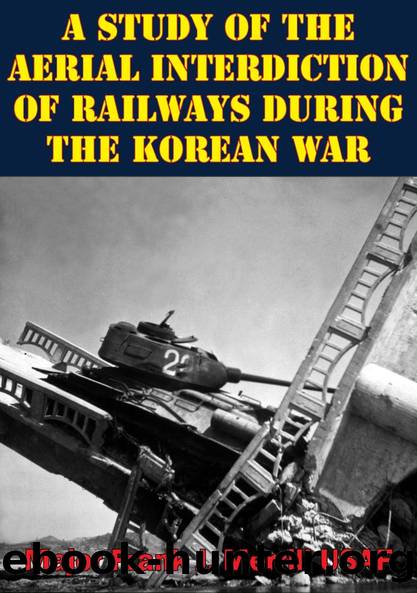
A Study Of The Aerial Interdiction of Railways During The Korean War by Major Frank J. Merrill USAF
Author:Major Frank J. Merrill USAF [USAF, Major Frank J. Merrill]
Language: eng
Format: epub
Tags: History, Military, Korean War, Asia, India & South Asia, Korea, Central Asia
ISBN: 9781786251947
Google: cDFvCwAAQBAJ
Publisher: Pickle Partners Publishing
Published: 2015-11-06T02:58:15+00:00
CHAPTER VIII â ARMISTICE TALKS MARK A NEW PHASE IN THE WAR (9 JULY 1951â27 JULY 1953)
At Peking and Moscow the leaders of international Communism must have at last recognized that victory for them in Korea was not to be had. In a radio address delivered in New York City on 23 May 1951. Soviet Russiaâs delegate to the United Nations, Jacob A. Malik, suggested that the time was ripe for a negotiated settlement of the Korean War. On 25 June 1951, General Ridgway, in marking the first anniversary of the war, broadcast a message to the Chinese people. In this message he stated that he could not understand why the Chinese leaders continued to sacrifice men when they knew that they were not going to be able to keep their boast of driving the United Nationsâ forces into the sea. In another broadcast on 30 June, General Ridgway proposed that a cease-fire meeting be held aboard a designated hospital ship in Wonsan Harbor. On 1 July the Communist answered that they âhad been authorized to suspend military activities and to hold peace negotiations.â They suggested that the Korean town of Kaesong should be the place for the conferences. Vice Admiral C. Turner Joy was named the chief United Nationsâ delegate to the truce-talks which begin at Kaesong on 10 July 1951. {161} These meetings marked the beginning of a new and unfamiliar type of war in Korea.
During May and June of 1951, despite the possibility that hostilities might soon be ending in Korea, FEAF planners had begun construction of some semi-permanent airfield facilities in South Korea. 9,000-foot runways were to be built at Taegu, Kunsan and Sowan airfields. Plans were made for the permanent deployment of Fifth Air Force units to Korea. Fifth Air Force Headquarters moved from Taegu to Seoul on 14 June. By the end of August 1951 all tactical units were operating from Korean bases. {162}
Fifth Air Force, the tactical arm of FEAF, was finally in position in Korea. For the first time since the outbreak of hostilities, FEAF was properly positioned to fight at full effectiveness. Bomber Command, although reduced from five to three groups due to the rotation of two groups back to SAC, was at full strength in aircraft and crews.
It is my intent to approach the study of the final period of rail interdiction from a âtype of interdictionâ point of view as opposed to any attempt at a chronological arrangement of missions or sorties. During this relatively static phase of the ground war, most air operations settled down into generally predictable and prescribed patterns. Routine day to day operations and the basic missions assigned each type of unit actually varied very little. Aircraft availability and crew strengths remained relatively constant. The most obvious variable of the entire operation was the constant changes in the areas of interdiction emphasis and in the various employment methods used to accomplish the mission. Each major change in emphasis will be outlined and an attempt will be made to explain the reasoning behind each change.
Download
This site does not store any files on its server. We only index and link to content provided by other sites. Please contact the content providers to delete copyright contents if any and email us, we'll remove relevant links or contents immediately.
The Vikings: Conquering England, France, and Ireland by Wernick Robert(84385)
Ali Pasha, Lion of Ioannina by Eugenia Russell & Eugenia Russell(40322)
The Conquerors (The Winning of America Series Book 3) by Eckert Allan W(37991)
The Vikings: Discoverers of a New World by Wernick Robert(37008)
Cecilia; Or, Memoirs of an Heiress — Volume 1 by Fanny Burney(32640)
Cecilia; Or, Memoirs of an Heiress — Volume 2 by Fanny Burney(32014)
Cecilia; Or, Memoirs of an Heiress — Volume 3 by Fanny Burney(31999)
Empire of the Sikhs by Patwant Singh(23140)
The Secret History by Donna Tartt(19317)
Hans Sturm: A Soldier's Odyssey on the Eastern Front by Gordon Williamson(18653)
Cat's cradle by Kurt Vonnegut(15447)
Pimp by Iceberg Slim(14690)
Sapiens: A Brief History of Humankind by Yuval Noah Harari(14469)
Norse Mythology by Gaiman Neil(13460)
Talking to Strangers by Malcolm Gladwell(13449)
Leonardo da Vinci by Walter Isaacson(13414)
4 3 2 1: A Novel by Paul Auster(12524)
Underground: A Human History of the Worlds Beneath Our Feet by Will Hunt(12150)
The Radium Girls by Kate Moore(12097)
